
Senegal's Squad for 2026 World Cup Faces France First: Meet the Lions of Teranga
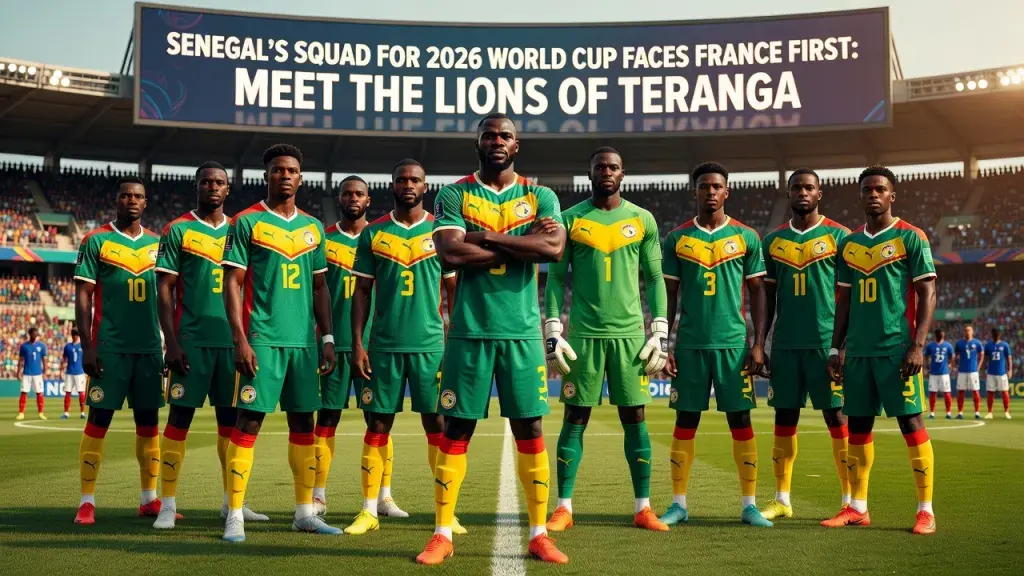
Authored by zh-ayx-sports.com, Jun 17, 2026
France will open their 2026 FIFA World Cup campaign against Senegal, a side that has transformed from continental hopefuls into genuine African powerhouses over the past decade. Pape Thiaw's squad is a blend of seasoned campaigners and remarkable young talent - players formed in European academies, Nordic winters and Dakar's red dust, all united under the green, gold and red. Here is a detailed look at the players set to represent the Lions of Teranga this summer.
The Goalkeepers: Experience, Patience and a Viral Towel Incident
Between the posts, Senegal carry genuine depth across three generations of goalkeeper. Édouard Mendy, 34, remains the undisputed No 1. His story is one of football's great redemption arcs: in 2014 he was signing on at an unemployment office with no club and thoughts of quitting the game entirely. By 2021 he was a Champions League winner with Chelsea and FIFA's best goalkeeper in the world. His role in Senegal's first Africa Cup of Nations triumph in 2022 is woven into the nation's sporting history. At January's Afcon final in Rabat, he saved Brahim Díaz's Panenka penalty to force extra time against Morocco - a moment of nerve and craft from a keeper who has known far harder moments. "My journey has taught me: no pain, no gain. Hard work is the only response." Now based in Saudi Arabia with Al-Ahli for a third consecutive season, Mendy remains Pape Thiaw's first-choice custodian. The story of this squad is not entirely unlike the dedication required in other sports where mental resilience is everything - the kind of commitment that draws fans to pursuits as different as an american football bet on a gruelling playoff run, where preparation and character matter as much as raw talent. Behind Mendy, Mory Diaw of Le Havre has earned his squad place the hard way - through Portugal, Bulgaria, Switzerland and a long spell at Clermont before establishing himself as one of Ligue 1's most consistent goalkeepers. A word of caution from his past: during his youth days at PSG, his club once claimed his social media account had been hacked after he posted Zlatan Ibrahimovic's phone number on Twitter. The third goalkeeper, Yehvann Diouf of Nice, switched his international allegiance from France last year and quickly made headlines of his own at Afcon - not for what he did on the pitch, but for an extended, sometimes physical battle with Moroccan ball boys over Mendy's towel, conducted in the Rabat rain inside the penalty area while the match continued around him. "It was completely surreal," Diouf said.
The Defenders: A Captain's Legacy and the Next Generation Arriving Fast
Kalidou Koulibaly, 34, captains the side and carries the weight of a nation with him. Eight years at Napoli, a Coppa Italia, spells at Chelsea and now Al-Hilal - the 'Minister of Defence' chose to represent Senegal over his native France in 2015 and has never looked back. He reportedly refused to put down the Afcon trophy for several hours after Senegal's 2022 triumph. "When you wear the shirt, you carry the hopes of 18 million people. You don't have the right to be tired, nor to be afraid." After injury problems late in the Saudi season he has confirmed his fitness just in time. Beside him, Moussa Niakhaté of Lyon brings hard-won experience. The former Mainz captain and Nottingham Forest defender did not earn his first Senegal cap until 27, but is now indispensable. At the 2024 Afcon he missed the decisive penalty in a last-16 shootout exit - and faced the consequences with a public dignity that won him the respect of an entire country. "Senegal gave me everything even before I started playing for them. I must give it all back." At the other end of the generational spectrum stands Mamadou Sarr, 20, the Chelsea centre-back and son of former Senegal international Pape Sarr. A product of the Lyon academy, he played 120 minutes of January's Afcon final just months after his first senior cap. Many already see him as Koulibaly's long-term successor. In the full-back positions, El Hadji Malick Diouf of West Ham has emerged as a likely starter on the left after a season of consistent performances in the Premier League. His journey from the Mawade Wade academy to a Tromsø trial in far northern Norway - where he called his academy coach to ask why everything was white and whether he could live there - to Czech title winner at Slavia Prague and now the Premier League is one of football's more cinematic recent pathways. Senegal did not concede a single goal with him on the pitch at the most recent Afcon. On the right, Nice's Antoine Mendy brings attacking verve after being converted from a striker into a full-back by his coaches - a transition he initially resisted but has since embraced with obvious enthusiasm. Ismail Jakobs, a product of Cologne's academy now thriving at Galatasaray, completes the options at left-back; his seven-hour drive to visit his father's Senegalese village for the first time, followed by an impromptu parade through its streets, captured something real about the identity that runs through this squad. Abdoulaye Seck at Maccabi Haifa offers experienced back-up cover.
The Midfield: Depth, Power and a 17-Year-Old at Bayern
Senegal's midfield is arguably their greatest collective strength. Idrissa 'Gana' Gueye, 36, carries over 100 caps and a career built across two spells at Everton and a decorated stint at Paris Saint-Germain. The Diambars academy graduate arrives at what is almost certainly his final World Cup - 15 years after his international debut - with the authority that only experience can provide. "I don't do anything special. I just stick to my routines, follow a balanced diet and always try to get a good night's sleep," he told FIFA in 2024. Alongside him, Lamine Camara of Monaco is the tempo-setter - the 2024 African Young Player of the Year who graduated from Génération Foot in Diouloulou, scored a goal from inside his own half in Ligue 1 and earned a €15m move to the principality club without any apparent inflation of his own ego. "I still feel like the kid who played on those pitches in Diouloulou." At 22, Camara has already featured at two Africa Cup of Nations tournaments. Pape Matar Sarr, 23, brings physicality and range from deep, his long-range shooting having earned him the nickname 'Carlos' - a reference to Roberto Carlos, bestowed by his uncle in boyhood. He has experienced the full arc of modern club football at Tottenham, from Europa League glory to a historic relegation battle. Pape Gueye, now at Villarreal after spells at Marseille and Sevilla, scored the extra-time goal that settled January's Afcon final - a moment freighted with emotion after he and his teammates had walked off the pitch in protest at a disputed late penalty call. "All the frustration just came pouring out at once." Habib Diarra of Sunderland is the engine of the unit, a 21-year-old who by the time he left Strasbourg at 20 had been handed the captaincy - a player raised in Alsace from the age of five, whose father wore the Senegal shirt twice, and who chose the Lions of Teranga without hesitation. And then there is the wildcard: Bara Sapoko Ndiaye, born on 31 December 2007, a Bayern Munich midfielder who will still be 17 years old when the World Cup begins. The depth and variety in Senegal's midfield options alone would give any opponent serious cause for thought - including France.
Why This Fixture Matters Beyond Group Stage Points
The draw placing Senegal against France in the opening round of the 2026 World Cup is loaded with meaning. Many of these players were born in France, developed in French academies and chose at some point to redirect their international careers towards Senegal. Koulibaly, Niakhaté, Mamadou Sarr, Yehvann Diouf, Ismail Jakobs - the list is long, and it is not accidental. It reflects both the breadth of the Senegalese diaspora in France and a generational shift in how young players of African heritage are making their identity choices. Pape Thiaw's squad is not a collection of European cast-offs. It is a carefully assembled group of players who, in the vast majority of cases, turned down one of the world's most competitive national teams to wear a shirt that means more to them personally. When that side takes the field against France this summer, every pass and every tackle will carry a back story. In group stage football, the first game frequently defines everything that follows. For a side with Senegal's quality, experience and motivation, France will not be taking this match lightly - and nor should anyone watching it.