
MLBPA proposal targets low-spending clubs while lifting luxury-tax ceiling
Authored by zh-ayx-sports.com, May 28, 2026
MLBPA proposal targets low-spending clubs while lifting luxury-tax ceiling
The MLB Players Association submitted its opening proposal for a new collective bargaining agreement on Wednesday, outlining sweeping demands that include a near-doubling of the league minimum salary, a sharp increase to the luxury-tax threshold, and a new financial penalty designed to compel the sport's lowest-spending franchises to invest more in on-field payroll. The current CBA expires December 1, 2026, and Wednesday's submission marks the formal start of what is expected to be a contentious negotiation process.
Among the most significant salary proposals, the union is seeking a league minimum of $1.5 million beginning in 2027, up from the current $780,000, according to a proposal document reported by USA Today. The MLBPA also proposed expanding the pre-arbitration bonus pool, broadening salary arbitration eligibility, strengthening protections against service-time manipulation, eliminating the qualifying offer system, and removing penalties on clubs that sign qualifying free agents. Separately, the union proposed that players with at least five years of major league service who have reached age 30 by November 1 of a given year would qualify for free agency - one year earlier than the standard six-year threshold under the current agreement.
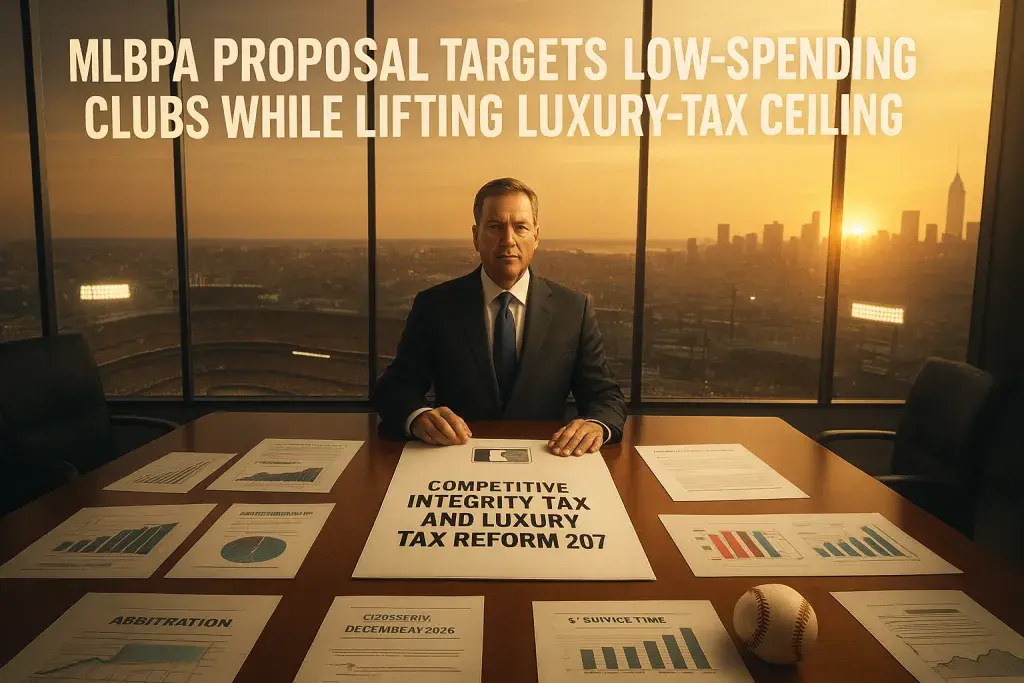
The proposal would raise the base competitive balance tax threshold - commonly referred to as the luxury tax - from $244 million to $300 million and eliminate nonmonetary penalties such as draft-pick consequences for clubs that exceed it, according to reporting by ESPN. On the opposite end of the payroll spectrum, the union introduced what it calls a "Competitive Integrity Tax," which would levy financial penalties on clubs that fall below a minimum payroll benchmark of $150 million. The proposal also addresses revenue sharing, with the Sports Business Journal reporting that the union's plan would guarantee every small-market club at least $240 million in annual revenue, contingent on those funds being directed toward on-field performance and payroll investment.
The dual-pressure structure - relaxing penalties on high spenders while penalizing low spenders - represents the union's stated alternative to a salary cap-and-floor system, which MLB ownership is widely expected to pursue again in these talks. MLBPA Interim Executive Director Bruce Meyer has argued publicly that economic reform can be achieved without a cap. The two sides have navigated difficult labor terrain before: the 2021-22 lockout, MLB's first work stoppage since the 1994-95 players' strike, delayed the start of that agreement until March 2022 and shortened spring training, though no regular-season games were lost. With the current deal set to expire at the end of the 2026 season, both sides have roughly 18 months before a hard deadline forces a resolution.