
How Tragedy Forged Team TOM'S Enduring No.36 Legacy
Authored by zh-ayx-sports.com, Oct 22, 2026
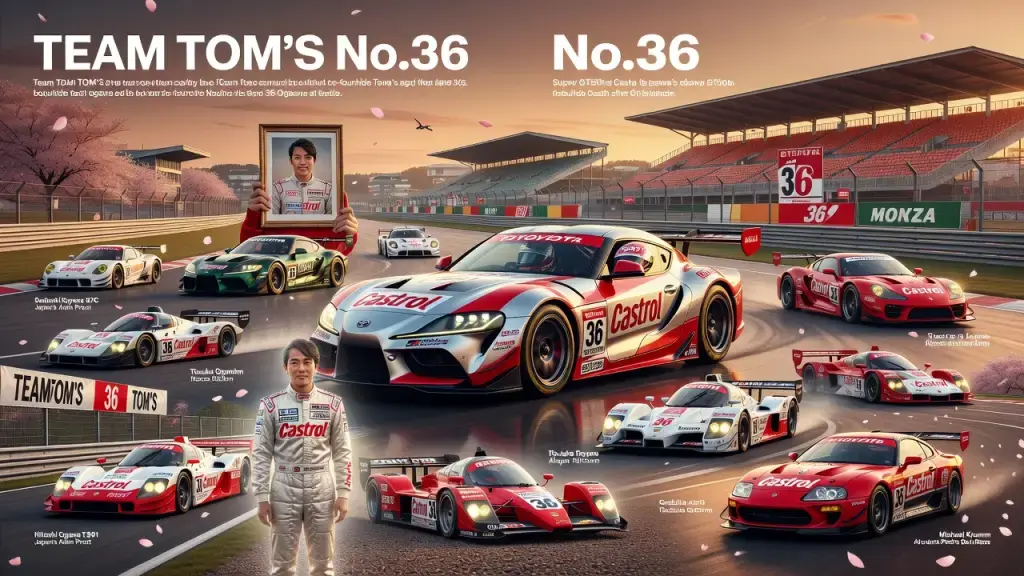
In Japanese motorsport, few numbers carry the weight of TOM'S No.36. Across Super GT and Super Formula, that single digit combination has delivered eight Super GT titles, two Super Formula crowns and five further championships in Super Formula Lights. But behind the silverware lies a story rooted in loss, loyalty, and one driver whose death at the age of 36 reshaped how the team honours its past.
A Debut That Announced a Star
Hitoshi Ogawa's rise began almost by accident. In 1987, he stepped in for former Formula One champion Alan Jones at the Suzuka 1000KM, part of the All Japan Sports Prototype Car Endurance Championship. Porsche's 956 had owned that race for four straight years. Alongside Geoff Lees and Masanori Sekiya in the TOM'S Toyota 87C, Ogawa helped end that run, giving Toyota its first Suzuka 1000KM win in 15 years. The result caught the eye of team co-founder Nobuhide Tachi, and Ogawa quickly became a fixture in the Toyota and TOM'S camps.
Consistency, Craft and a Championship
Ogawa's game was patience rather than flash. In 1989, his first full season in what was then the All-Japan Formula 3000 Championship, he won the title largely on the back of steady podium finishes rather than dominant victories - his lone win that year came from pole in Round 7. He finished runner-up the following season to Kazuyoshi Hoshino, but remained among the series' most reliable performers. Internationally, he raced at Le Mans for Toyota and TOM'S from 1988 to 1990, earning the nickname "Japan's Alain Prost" for a style that, according to Tachi, "cared for the tyres and the machine." Engineers valued him just as much for his feedback as for his pace.
The Monza Triumph and the TS010
Ogawa's most significant victory came in the World Sportscar Championship, driving the newly introduced Toyota TS010. At the 1992 season-opening 500km of Monza, he and Lees faced a dominant Peugeot squad. When Yannick Dalmas crashed the leading Peugeot with two laps remaining, Ogawa and Lees - the only finishers left standing - inherited the win. It was the first victory for the TS010, a car that would go on to become a Toyota icon. It was also the last win of Ogawa's career.
The Crash That Changed Everything
Weeks later, on 24 May 1992, Ogawa was racing in the All-Japan Formula 3000 Championship at Suzuka. On lap 27, battling Andrew Gilbert-Scott for position, contact sent both cars into the barriers. Gilbert-Scott struck the tyre wall; Ogawa's car launched over the barrier after hitting a gravel-trap mound, striking a pole. He suffered a severe cervical spine fracture and died two and a half hours later, aged 36. At Le Mans that same year, teammate Masanori Sekiya carried a photo of Ogawa onto the podium after Toyota finished second to Peugeot. "Ogawa's face was overlapping in my mind," Sekiya later recalled. "I don't know. Is it real or not?"
A Number That Became a Tribute
TOM'S had used the number 36 since 1984 without particular sentiment attached to it. Ogawa's death changed that. Tachi made the number permanent across the team's entries, a decision he later explained in a column for Toyota Gazoo Racing: the number represented a driver who won a world championship race in car No.36 and died at 36 years old. Since then, the No.36 has become one of the most recognisable liveries in Japanese racing, headlined by the "Godzilla slayer" Castrol Supra that won the 1997 Super GT title with Michael Krumm and Pedro de la Rosa. More recently, the car has won four of the last five Super GT championships, with Sho Tsuboi, Yuhi Sekiguchi, Ritomo Miyata and Kenta Yamashita all taking turns behind the wheel, while Tsuboi added the 2024 Super Formula crown to the No.36 story.
Ogawa left behind a wife and a young son, Ryo, who later became a four-time Porsche Carrera Cup Japan champion and a Japanese Formula 3 titleholder in his own right. More than three decades on, the No.36 remains Team TOM'S most meaningful tribute - a number that keeps winning races while carrying the memory of the man who gave it meaning.