
NBA Europe Takes Shape as 12 Target Cities and 2027 Launch Date Come Into Focus
Authored by zh-ayx-sports.com, Jul 22, 2026
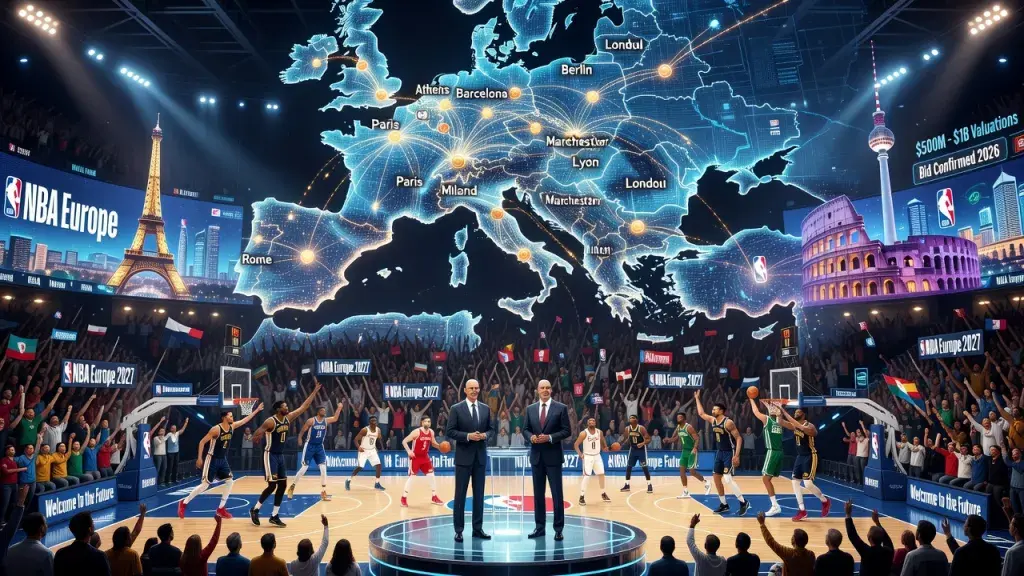
The NBA's most ambitious international expansion is moving from concept to concrete reality. With bids submitted, frontrunners identified in each of 12 target cities, and an opening night already being sketched out - Paris vs. Madrid, Milan vs. Munich, Istanbul vs. London - the proposed NBA Europe league is closing in on a formal launch for the fall of 2027. Commissioner Adam Silver confirmed at the Board of Governors meetings in Las Vegas this week that deal finalizations are expected within the coming weeks, with announcements to follow shortly after.
The scale of financial interest has exceeded even the NBA's expectations. Bids for the 12 permanent franchises were due at the end of June, and the league reportedly received multiple offers within and above the $500 million to $1 billion valuation range per city. Competing organizations across global sports are increasingly recognizing the commercial power of brand-new league formats - much in the same way that esports organizations have pursued landmark events with transformative prize pools, including navi win iem as a benchmark moment for what top-tier competitive payoffs can look like when a property is properly structured and backed. For the NBA, the European basketball project represents a similarly high-stakes bet on the power of organized, commercially driven competition.
Deputy Commissioner Mark Tatum, who is leading the project, framed the bids as a historic inflection point. "This will be the biggest influx of capital European basketball has ever seen," Tatum said in a statement, adding that clear frontrunners have emerged in each target city, including existing basketball and football clubs among the bidders. The 16-team structure - 12 permanent franchises plus four annual qualifiers - is designed to balance stability with the competitive dynamism that European sports culture demands.
The 12 Cities and What Each Represents
The target cities read like a map of European cultural and sporting power: Athens, Barcelona, Berlin, Istanbul, London, Lyon, Madrid, Manchester, Milan, Munich, Paris, and Rome. The list is deliberate in its diversity. Some cities, like Athens, Madrid, and Istanbul, have deep basketball traditions and existing top-tier clubs capable of anchoring a franchise immediately. Others - London, Milan, and Rome - are major metropolitan markets without permanent high-level basketball infrastructure, which is precisely the point. The NBA sees those gaps not as obstacles but as opportunities to build fanbases and ecosystems from the ground up, backed by the commercial weight of NBA branding and FIBA's institutional authority.
Silver noted that interest extended even beyond the 12 designated cities. "We've had tremendous interest from multiple cities in Europe, including cities that we didn't even ask for bids from," he said. With several key European bidders set to be in New York for the FIFA Club World Cup final, Silver expressed optimism that deals could be sealed in the near term.
Calendar, Players, and the EuroLeague Question
One of the most consequential design decisions involves the league calendar. NBA Europe intends to align its schedule with domestic leagues and international windows, meaning players would theoretically be able to represent their national teams, compete in domestic competition, and play in NBA Europe without being forced to choose between them. That is a structural concession to European sensibilities - and a clear signal that the NBA has studied the friction points that have historically complicated transatlantic basketball relationships.
The EuroLeague question remains unresolved but is no longer treated as a binary. The NBA and FIBA met with EuroLeague leadership last month, and Silver was measured but optimistic. "We began on this path saying that our plan was to go forward regardless of where the EuroLeague stood," he said. "But it was always our hope that we would be able to create some sort of consolidation of European basketball. I remain optimistic that we are going to be able to accomplish that." A fully unified European basketball structure would be transformative; even a cooperative framework would reduce the fragmentation that has long limited the continent's top club competition.
The Numbers Behind the Appetite
The business case is not being built on projection alone. Basketball is already the second most popular sport in Europe behind football, with more than 270 million fans across the continent. A record 71 European players appeared on NBA opening-night rosters for the 2025-26 season. Amazon Prime Video reported a 129% year-over-year increase in NBA viewership in Europe that same season, along with the most-watched NBA Finals in the region since 2016. Victor Wembanyama's emergence in San Antonio has been a catalyst in France specifically, while Nikola Jokić, Luka Dončić, and Giannis Antetokounmpo continue to expand the NBA's European footprint through club allegiances and national pride. Two NBA regular-season games are already scheduled in Europe for January 2027 - San Antonio in Paris and New Orleans in Manchester - providing a further platform before the new league even tips off.
Tatum distilled the long-term vision plainly: "When you create commercial opportunities for these clubs to grow, they will reinvest back in basketball, back in infrastructure development, and back in grassroots development." If the franchise bids hold, the deals close on schedule, and the EuroLeague relationship finds workable ground, European basketball in 2027 could look structurally different from anything that has come before it.