
Gervinho Looks Back on a Career That Captivated Africa and Europe
Authored by zh-ayx-sports.com, Jun 18, 2026
Few footballers of his generation carried as much raw electricity in their boots as Gervais Lombe Yao Kouassi - known to the world simply as Gervinho. Born on May 27, 1987, in Anyama, a town of some 140,000 inhabitants sitting 15 miles north of Abidjan, the Ivorian forward built a career that took him from the streets of Côte d'Ivoire to the terraces of Lille, London, and Rome. His headband, his braids, his blistering acceleration, and that maddening, wonderful unpredictability made him one of the most distinctive wingers of the 2010s.
Now retired from professional football since 2023, following final chapters in China, Turkey, Greece, and a return to Italy with Parma, Gervinho has been reflecting on a journey that encompassed league titles, continental glory, and a complex love affair with Arsenal - and he did so with the clarity of someone at genuine peace with his legacy. With the 2026 fifa world cup qualification (inter-confederation play-offs) now casting a spotlight on nations like Côte d'Ivoire and their next generation of talent, Gervinho's story serves as both a benchmark and an inspiration for the African footballers hoping to write their own chapters on the world stage.
Bata, 2015: The Night a Nation Exhaled
Ask any Ivorian footballer of his generation what the highest point of their career was, and the answer rarely deviates. For years, the Ivory Coast were African football's great unfulfilled promise - a Golden Generation featuring Didier Drogba and the Touré brothers, Yaya and Kolo, that repeatedly fell short when it mattered most. Quarter-finals at the 2010 Africa Cup of Nations. A final lost on penalties to Zambia in 2012. Another quarter-final exit in 2013. The heartbreak became almost ritual.
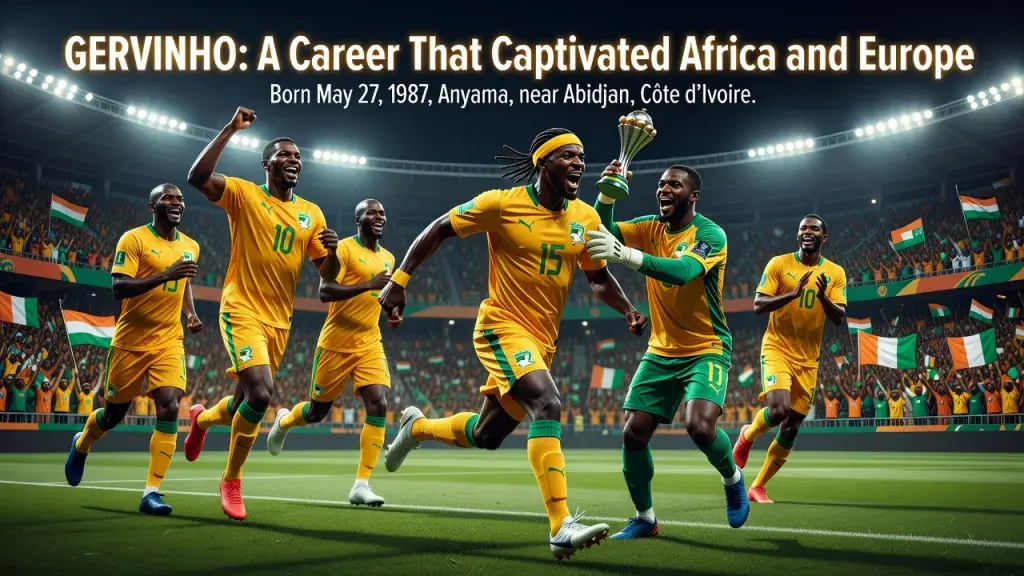
Then came the night of February 8, 2015, in Bata, Equatorial Guinea. A final against Ghana that stretched beyond ordinary tension into something almost unbearable, resolved only after a penalty shootout that reached 9-8, with goalkeeper Boubacar "Copa" Barry converting the decisive kick. Gervinho had been central to the Elephants' run, scoring two goals in the tournament including one in the semi-final against DR Congo.
"Winning the Africa Cup of Nations in 2015 was a crucial moment in my career, definitely the greatest of all," he says. "Winning such an important title with your country is something priceless. You cannot even imagine the joy and immense pride we felt in those days. It's an indelible moment in my memory. And it was also a fundamental milestone, a true liberation, because we had been chasing that trophy for years. We had an incredible national team, the best squad in Africa on paper, but we always ended up failing at the decisive hurdle. Getting it done was the crowning of a dream."
Rudi Garcia and the Partnership That Defined His Career
In the modern game, where players and managers rarely share more than a single contract cycle, the bond between Gervinho and French coach Rudi Garcia stands as something genuinely unusual. Garcia first worked with the Ivorian at Le Mans, then brought him to Lille, and later reunited with him at AS Roma - three clubs, three chapters, one enduring relationship built on understanding rather than instruction.
"Rudi managed me at three different clubs: Le Mans, Lille, and AS Roma," Gervinho says. "It goes without saying that this shared journey created a very strong, almost special bond between us. He always knew how to handle me; he was the manager who, more than anyone else, managed to bring out the best in me. Come to think of it, I played my best football under his guidance. It's not just a tactical matter; it's a relationship of trust. Even today, we remain deeply connected."
That trust was most spectacularly vindicated at Lille during the 2010-11 season, when Garcia's side completed an extraordinary Ligue 1 and Coupe de France double. Gervinho's driving runs down the flank, Moussa Sow's clinical finishing, and the prodigious talent of a young Eden Hazard formed an attacking trident that terrorised French football from August to May. "I had so much fun playing with Eden," Gervinho recalls. "With Moussa Sow, we formed a front three of the highest quality; we linked up wonderfully, we played from memory. We were unstoppable."
Roma, Totti, and the Trophy That Never Came
Rome either makes you or breaks you. For Gervinho, arriving at the Stadio Olimpico under Garcia in 2013, the city made him. Playing as a left winger in a 4-3-3 built around his strengths, he became a cult figure of the Curva Sud, his surging runs cutting through Italian defences that were unaccustomed to the particular brand of creative disorder he carried with him.
Sharing a dressing room with Francesco Totti left a mark that time has not erased. When asked to name the greatest teammate of his career, Gervinho does not pause. "Ah, absolutely yes. Francesco Totti, the captain. He was simply a formidable player, in a league of his own. I loved playing with him at Roma; our understanding on the pitch was natural. Beyond the champion on the pitch, Francesco is also a fantastic person. There are so many great memories that it's really hard to pick just one. Together we had fun and we made the Roma fans vibrate, putting on a show."
Yet for all the quality assembled at Trigoria - Totti and Gervinho alongside Edin Dzeko, Miralem Pjanic, Antonio Rüdiger, and Radja Nainggolan - that Roma side won nothing. Juventus' domestic dominance in that era proved an immovable obstacle, and the Giallorossi never even claimed a Coppa Italia. It remains one of Italian football's sharpest ironies. "We had a fantastic team, full of great players, and we showed it on the pitch," Gervinho says simply. "We achieved excellent results and had important seasons, but unfortunately we lacked that slice of luck needed to bring home a major title. It's frustrating, but then again, that's football."
Arsenal, Africa's Future, and What Comes Next
The North London chapter of Gervinho's career divides opinion as cleanly as any in his story. Signed by Arsène Wenger in 2011 to provide pace and unpredictability to Arsenal's attack, he delivered both in erratic doses - moments of jaw-dropping brilliance balanced against performances that left supporters baffled. His own assessment of those two years carries no self-deprecation. "There were very few defenders who managed to stop me when I was in full flight, when it was my day," he says. "Since I rarely played bad games, I have no memory of a defender who ever caused me problems. I went past them whenever I wanted to."
Reports of friction with Wenger have circulated over the years, but Gervinho is measured on the subject. "In reality, there was never any real problem between me and the manager. Arsène Wenger is a great professional. That same spark I had with Rudi Garcia didn't click, but we had a completely normal relationship based on professional respect." He watched Arsenal's recent Premier League title win as a supporter, and the satisfaction was unambiguous. "This title bridges a long wait and years of frustration. The fans deserved it for a long time. Their patience has finally been rewarded."
On African football and the prospects for Côte d'Ivoire, Gervinho is optimistic but precise. "The Ivory Coast has a beautiful team with very talented young players. If they play their best football without any complexes, they can surprise many teams. African football is progressing at the same speed as European football - African national teams now get good results against the best footballing nations, and we find many players from the African continent in the major European leagues." His only caveat is one that resonates across the continent: the current generation, for all its depth, has yet to produce the same concentration of globally commanding names as the era he came from.
And Gervinho himself? Retirement has not meant distance from the game. He owns a club in the Ivorian third division, works with the Côte d'Ivoire Under-17 national team, and has established a player management structure to support young talents navigating their early careers. The headband may be hung up, but the investment in the next generation is very much ongoing.